
Argus
Building a wearable medication safety system from off-the-shelf hardware
Medication errors are one of the more uncomfortable facts of clinical practice. They happen in approximately 10% of ICU patient days, and roughly half of those errors occur at the point of administration — not in prescribing, not in dispensing, but in the final step, when the drug actually reaches the patient.1
The standard response to this has been barcode medication administration (BCMA): scan the drug, scan the patient’s wristband, verify both against the electronic prescription. It works well in principle. In practice, it is undermined by its own ergonomics. Scanning requires picking up a handheld device, stepping away from the patient, finding the right screen. In a busy anaesthetic room or at a resuscitation trolley, this friction is enough that compliance is consistently poor.2
The question I kept coming back to was: what if the verification happened in your field of view, without you having to look away from the patient?
Consumer hardware has quietly reached a point where this is buildable without a research budget. Head-mounted displays, edge compute boards, and imaging sensors are all available off the shelf for tens of pounds. So I built a proof-of-concept to find out how far you could get.
The result is Argus — a modular wearable system built around the Brilliant Labs Frame, a monocular HMD, paired with a Raspberry Pi Zero 2W and a camera module, housed in custom 3D-printed brackets I designed iteratively in FreeCAD. The whole thing runs on a small USB power bank clipped to a lanyard.
The software scans both the patient’s wristband and the drug packaging. Medication barcodes come in two formats: traditional barcodes encoding the GTIN, and DataMatrix codes which also encode batch number and expiry date. Once identified, the drug details are verified against the Dictionary of Medicines and Devices (DM+D) and checked against a mock electronic prescribing record. The result is displayed directly in the HMD — no diverting attention, no putting anything down.
The hardware went through several iterations. The first mounting brackets were printed in nylon as a two-piece clamp, which worked but were bulky. Later versions reduced weight significantly, added heat-set inserts for a more durable connection, and integrated small magnets allowing the imaging module to be swapped quickly — useful because I trialled two different camera setups: a dedicated barcode reader and the Raspberry Pi AI Camera, which is capable of running small object recognition models directly on-device.
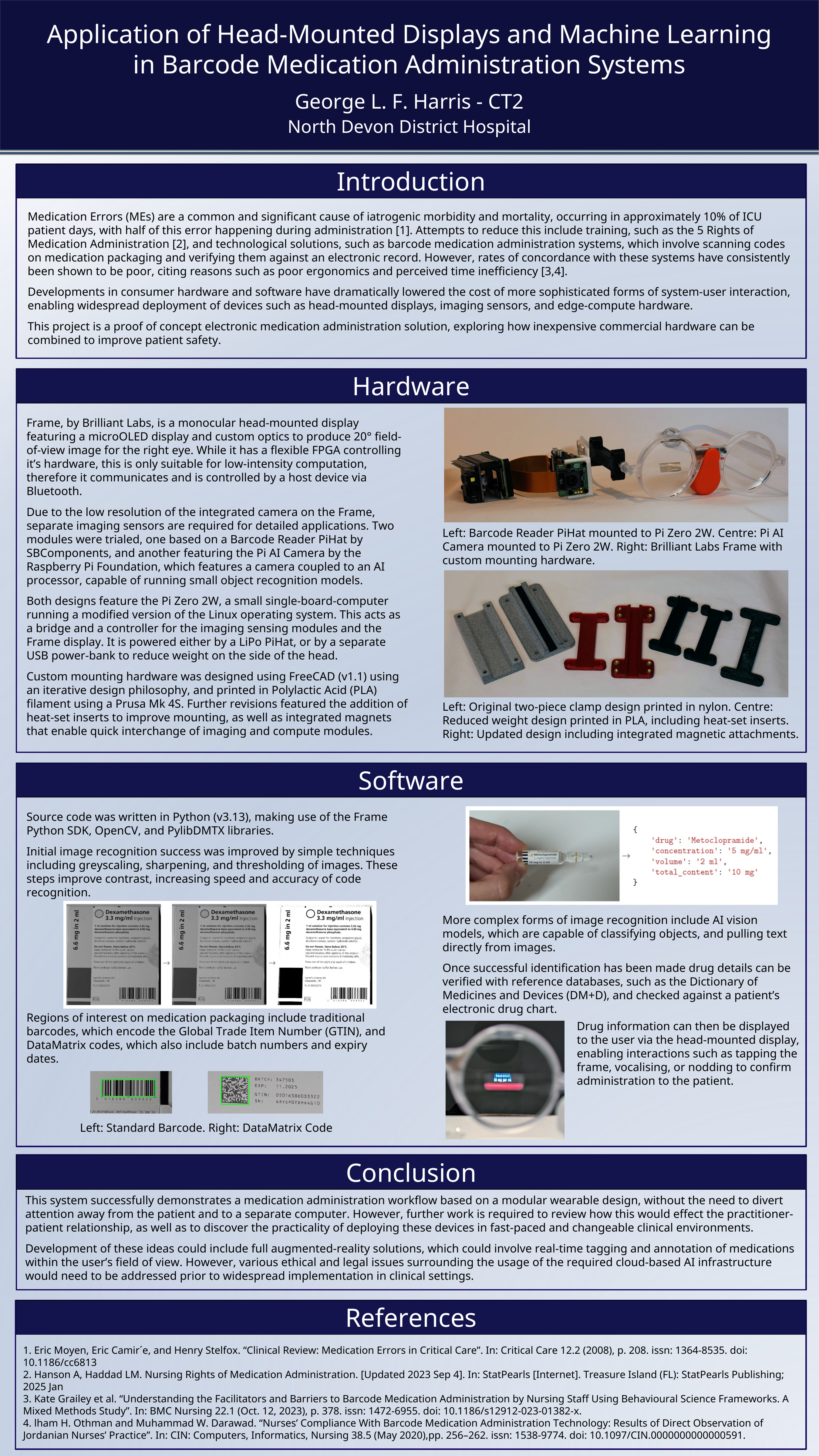
The system was presented as a poster at the ICS State of the Art Conference in December 2025,3 which was a useful forcing function for actually getting it to a presentable state — there’s nothing quite like a submission deadline for making you finish things.
The honest conclusion from the project is that the concept is demonstrably buildable. The workflow works. What remains unresolved is whether it would actually be used — and that’s a much harder question than the engineering one. The practitioner-patient relationship in anaesthesia is already mediated by a lot of equipment; adding something to your face raises legitimate questions about how that affects trust and communication that I haven’t begun to answer.
The further horizon is more interesting still. True augmented reality — real-time annotation of medications and equipment within your field of view — is technically achievable with current hardware. But that path runs into cloud AI infrastructure, which brings its own set of ethical and governance questions that would need to be worked through carefully before anything like it went near a clinical environment.
For now, the code and CAD files are all on GitHub if you want to build one yourself, or just have a look at how it fits together.
-
Moyen E, Camiré E, Stelfox HT. Clinical review: Medication errors in critical care. Critical Care. 2008;12(2):208. ↩
-
Grailey K et al. Understanding the facilitators and barriers to barcode medication administration by nursing staff using behavioural science frameworks. BMC Nursing. 2023;22:378. ↩
-
Harris GLF. Argus: A Proof of Concept Head-Mounted Barcode Medication Administration System. Journal of the Intensive Care Society. 2025 (ICS State of the Art Conference supplement, in press). ↩