
The People's Phantom
An open-source blueprint for democratising ultrasound-guided procedural training
Ultrasound-guided vascular access is now a core procedural skill for anaesthetists and intensivists. Teaching it well requires practice on something that behaves like tissue — something that resists the needle, returns recognisable echoes, and lets learners make mistakes without consequences. Commercial phantoms do this. They also cost several hundred pounds each, degrade with use, and generate a meaningful quantity of non-recyclable silicone waste when they reach the end of their life.
A phantom that costs £5 to make, biodegrades completely, and can be reproduced by anyone with a 3D printer is a different proposition entirely. That was the premise behind this project.
The design has three components.
The housing is a two-part PETG box, designed in FreeCAD and printed on a Prusa CoreONE. The lid has a pour hole for filling the phantom with gel; the base holds the targets in position through a set of small pegs. PETG tolerates the temperature of molten agar much more readily than PLA, which would just leave you with a twisted mess.
The targets are uninflated party balloons filled with water and red food colouring — cheap, instantly available, and surprisingly effective at mimicking a vein. The red colouring gives immediate visual feedback when a needle punctures the target rather than tracking alongside it, and the balloon wall offers just enough resistance to reward good technique. They sit wound around the pegs in the lower half of the housing.
The gel is an agar-based recipe: agar at 5% by weight, plain flour for scatter, xanthan gum for viscosity, and a small amount of red food colouring. The mixture is heated to 90°C, cooled to around 60°C with constant stirring, then poured through the lid into the housing around the pre-positioned targets. It sets in the fridge overnight. The whole thing is fully biodegradable, and when the gel eventually degrades it can be dissolved and replaced for the cost of a few pence of agar.
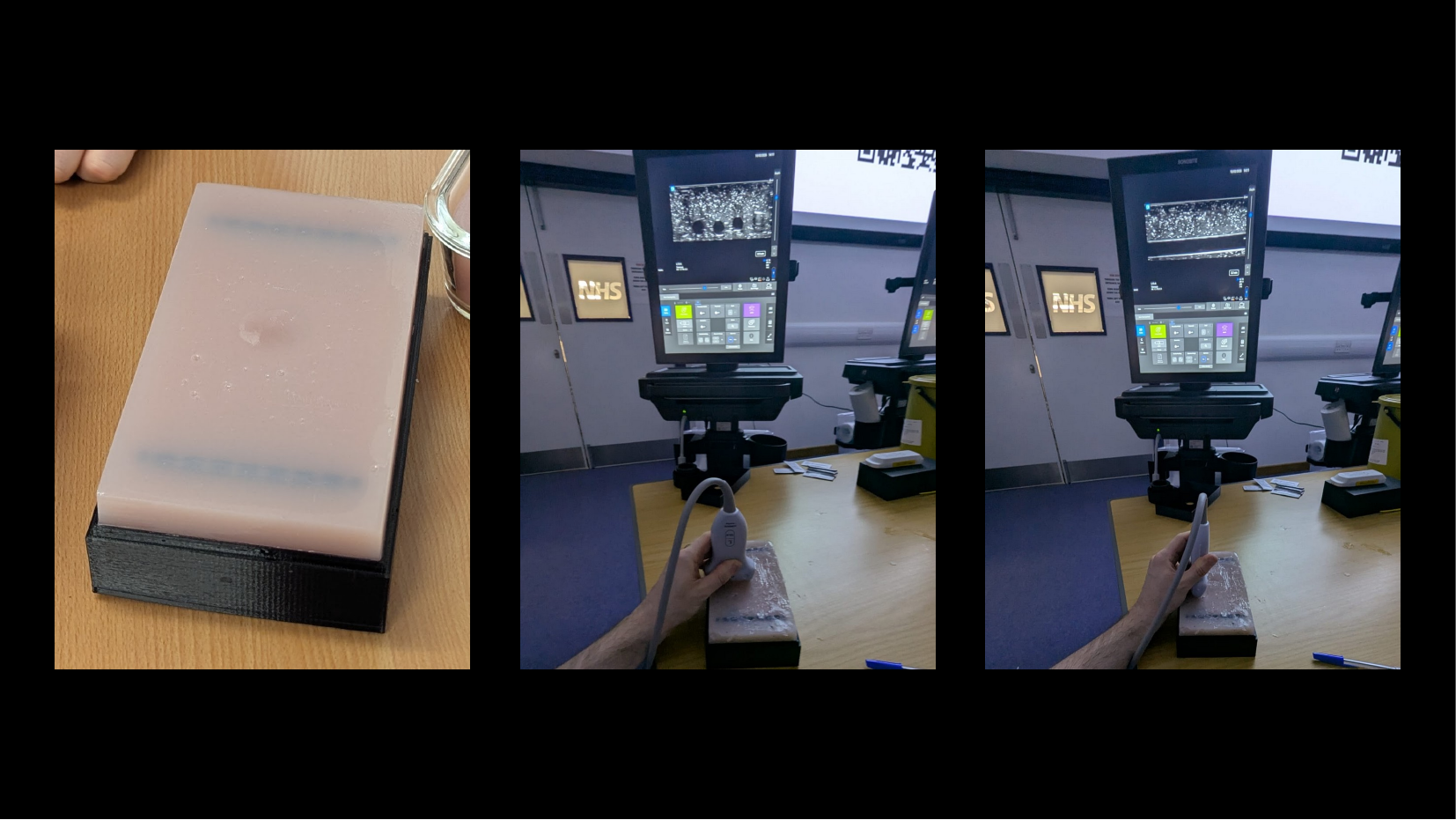
The phantoms were introduced into USS-guided cannulation teaching for resident doctors at North Devon District Hospital, and the programme subsequently expanded to IMT trainees for USS-guided central venous access using a second-generation modular design. The phantoms have since been shared with neighbouring departments and regional trusts, and the designs are released into the public domain with no restrictions on use or modification.
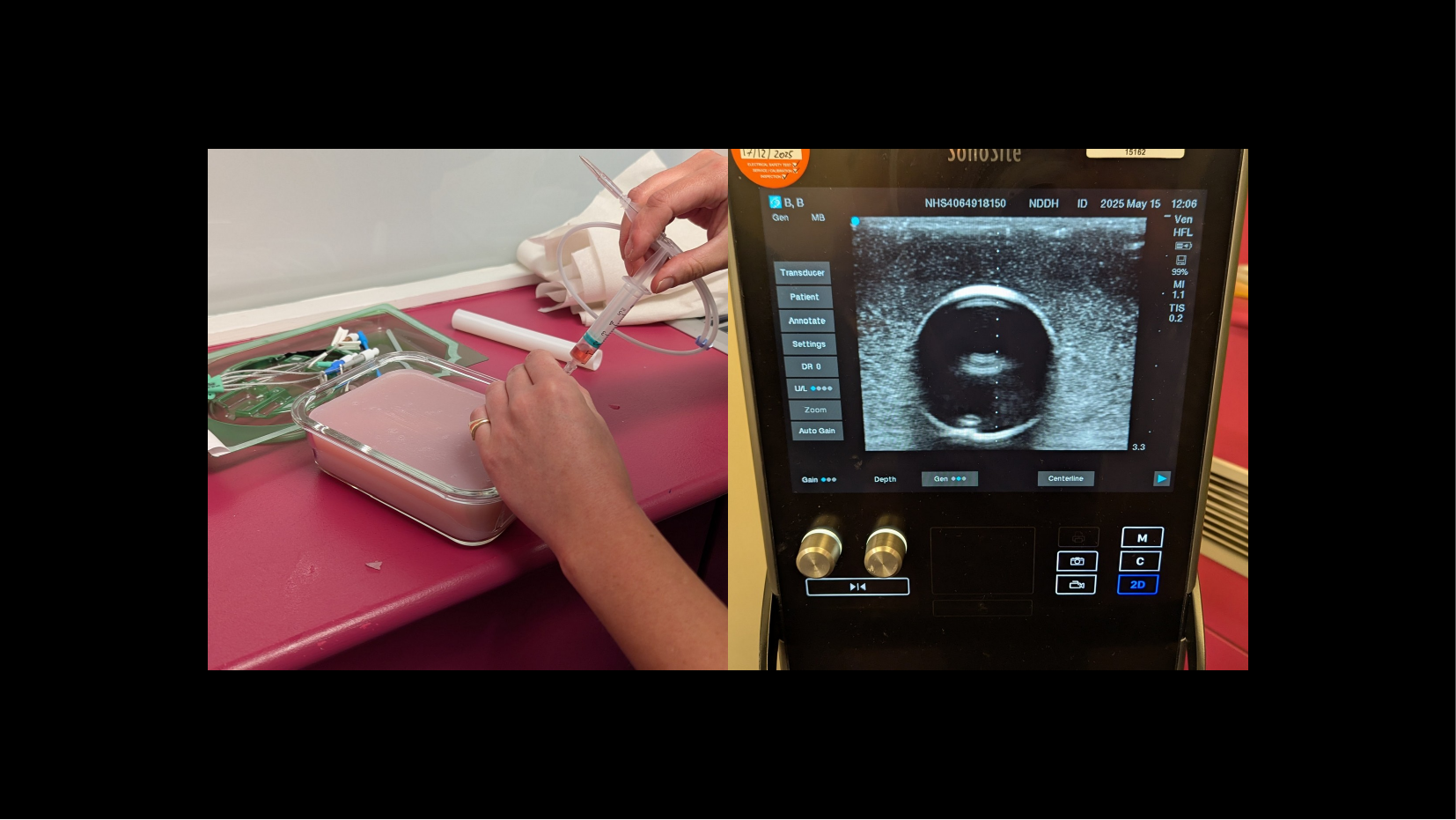
The more interesting development happened when I started thinking about what else you could put inside a phantom.
If the target is the problem to solve, then the target can be anything you can model. CT scan segmentation opens up the full range of human anatomy. I used 3D Slicer to segment CT datasets, exported the resulting meshes, and printed anatomically realistic structures: vessel bifurcations, a skull, and layered tissue representations for fascial plane techniques. These can sit inside the same gel matrix, in similar 3D-printed housings.
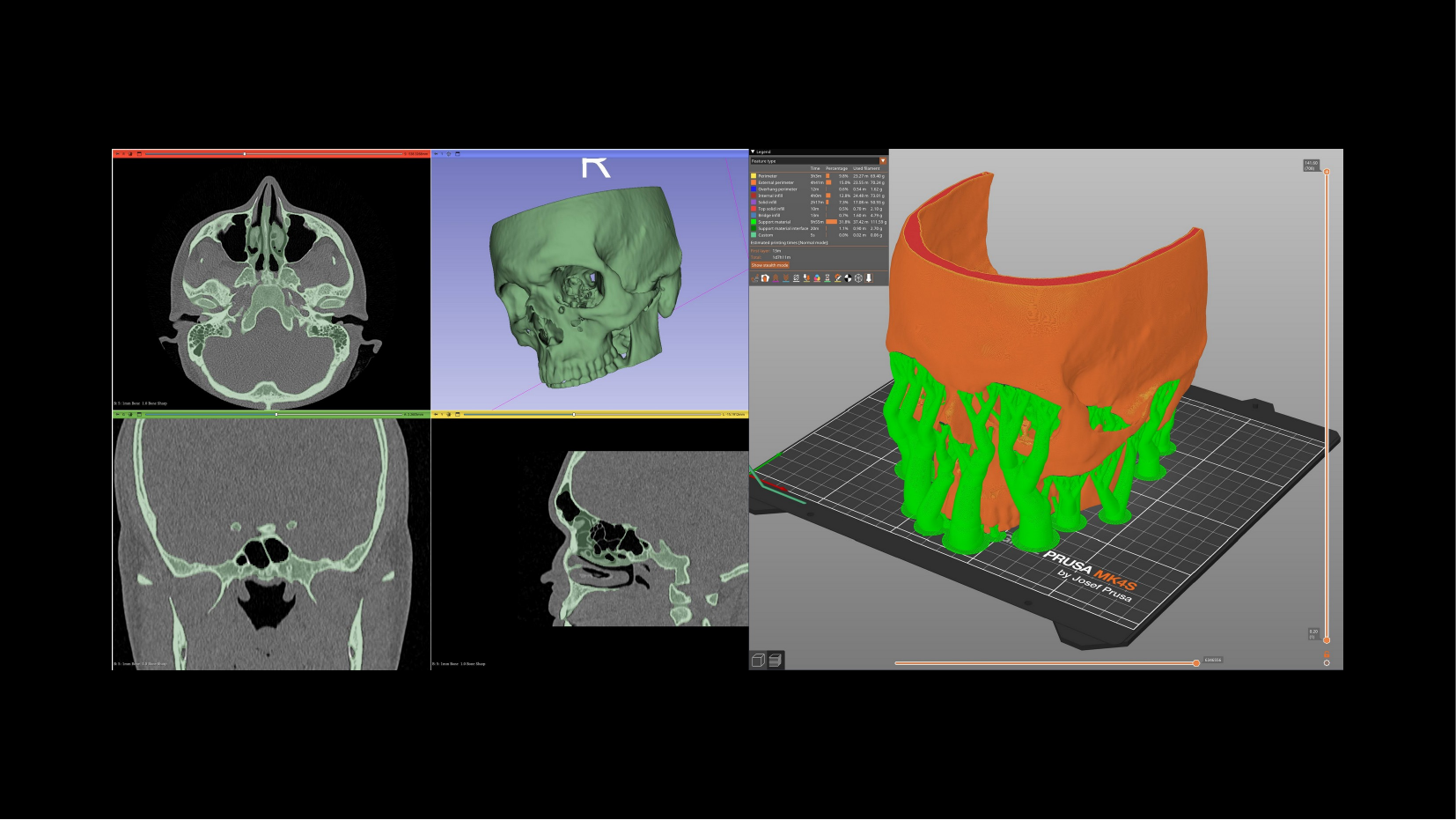
The further applications follow naturally. Fascial plane blocks require tactile and visual feedback when the needle tip reaches the correct tissue plane; a phantom with distinct agar layers of slightly different densities or interleaving membrane could replicate the characteristic ‘pop’ of fascial penetration and the spread of local anaesthetic within a plane. Learning epidural insertion requires knowing what the sensation of a needle passing through ligament feels like, which can be mimicked by printing low-infill flexible filaments. None of this requires any new technology, just the patience to iterate on the design.
This work was presented as an oral presentation at the Regional Anaesthetic Fellows and Trainees (RAFT) Annual Scientific Meeting in February 2026, under the title “The People’s Phantom: an open-source blueprint for democratising medical education and bridging the simulation gap.”
All designs and fabrication files are released into the public domain. If you want to build one, or adapt the design for a different application, everything is available on GitHub.